Restate’s flexible SDKs allows you to implement a large set of useful patterns in a few lines of code.
// the request router for the target service
const callee = restate.router({
  call: async (ctx: restate.RpcContext, request: { arg: string }) => {
    // this will be reliably invoked via a durable event from the caller
  }
});

// defines the logical location and the type signature
const calleeApi = { path: "callee" } as restate.ServiceApi<typeof callee>

// invoke from another Restate-backed service
const result = await ctx.rpc(calleeApi).call("hello " + request);

// invoke (or re-attach) with an external client
`curl http://<restate>/callee/call --json '{"request": {"arg": "..."}}' -H 'idempotency-key: <key>'`
// keyed routers enforce a single-writer for all methods of a router
// the second function parameter (the key) defines the single-writer identity
const userService = keyedRouter({

  updateUser: async (ctx: RpcContext, userId: string, update: any) => {...},

  moveUser: async (ctx: RpcContext, userId: string, move: any) => {...},

  deleteUser: async (ctx: RpcContext, userId: string) => {...}
});
// make calls from Restate to a service idempotently across retries/suspensions
async function invoke(ctx: restate.RpcContext, request: RequestType) {

  // deterministic random takes part in durable execution
  const idempotencyToken = ctx.rand.uuidv4();

  // side effect captures response and avoids retries after first success
  await ctx.sideEffect(() => api.makeCall(request, idempotencyToken));
}

// invoke functions idempotently from external clients
`curl http://<restate>/myservice/invoke -H 'idempotency-key: <key>' --json '{"request": {...}}'`
const handleWorkflow = async (ctx: restate.RpcContext, req: Request) => {
  // create a promise/future that can be completed externally
  const restatePromise = await ctx.awakeable();

  // pass the promise ID along with the call to external system
  await ctx.sideEffect(() => clnt.doSomething(restatePromise.id))

  // blocks (and suspends) until the promise is completed by external system
  await restatePromise.promise;
};
// function will automatically journal actions and recover from partial
// progress to ensure all writes get applied
async function applyChange(ctx: restate.RpcContext, request: UpdateRequest) {

  // write 1: Update the database. Will be automatically retried on failure.
  const clientToken = ctx.rand.uuidv4();
  await ctx.sideEffect(() =>
      dynamodb.idempotentInsert(request.dbUpdateRecord, clientToken));

  // write 2: send a message
  ctx.send(messageSender).publish(request.kafkaMessage);

  // write 3: set some Restate state
  ctx.set("status", request);
};
const handleWorkflow = async (ctx: restate.RpcContext, req: Request) => {
 // do something

 // delayed background task that will execute exactly once
 ctx.sendDelayed(otherService, 10_000).doSmt(req);
};
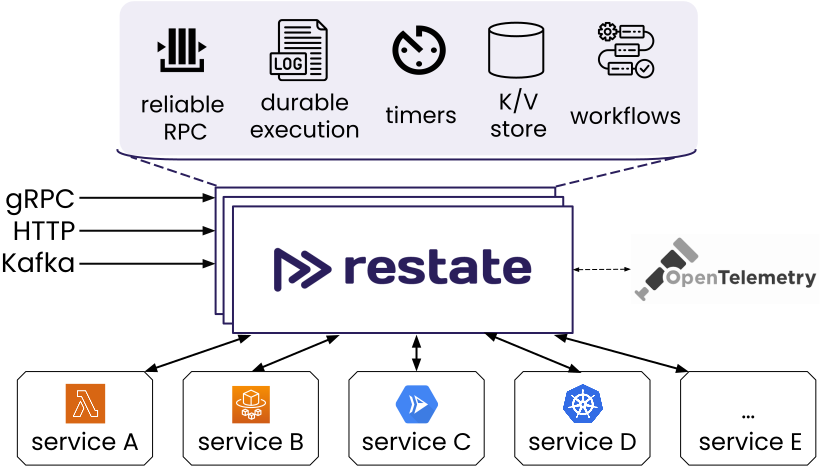
Restate implements low-latency durable execution with a partitioned command log.
The Restate Runtime pushes invocations to services and functions, journals the execution, and handles retries and failover. Via the journal, functions can recover partial progress after failures or actively suspend when waiting.
Restate stores long-lived k/v state for functions and pushes relevant state together with invocations.
Restate comes as a single binary that runs without any dependencies. It runs as well on your laptop as it does in the cloud.
Restate is built for modern cloud architectures and works seamlessly with services standalone, on FaaS (AWS Lambda), and as scale-out deployments on container engines like Kubernetes.
Detailed insight in execution progress and state across services
Generate OpenTelemetry traces and call trees for services, without any code or configuration.
Restate's unique way of managing inter-service communication and durable execution together means that it can generate detailed observability data right out of the box.